

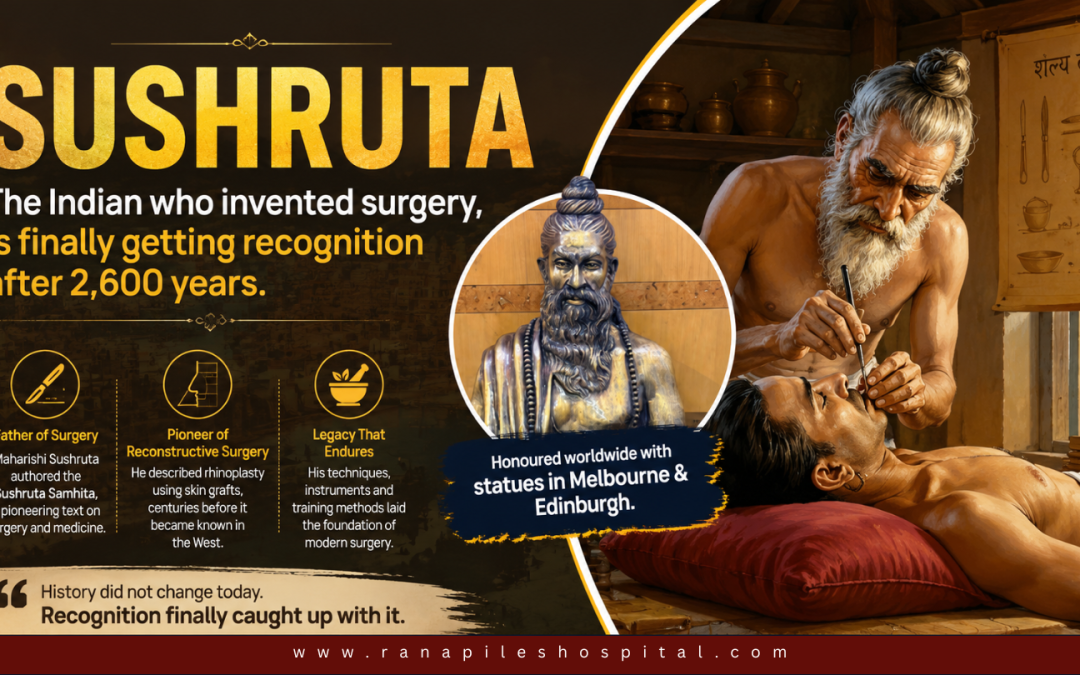
Modern surgery owes a profound debt to an Indian physician who lived more than 2,600 years ago. Long before hospitals, operating theatres, or formal medical degrees existed, Maharishi Sushruta was documenting surgical procedures in ancient Varanasi. His monumental work, the Sushruta Samhita, described hundreds of diseases, surgical instruments, anatomical observations, and operative techniques that would remain unmatched in many parts of the world for centuries.
Among his most remarkable contributions was rhinoplasty using skin grafts, a reconstructive procedure that later became known internationally as the famous “Indian Method.” His teachings established many of the principles that continue to guide surgical science today, earning him the title of the “Father of Surgery.”
Today, the world is increasingly acknowledging this extraordinary legacy. The recent installation of statues of Maharishi Sushruta in Melbourne, Australia, and at the Royal College of Surgeons of Edinburgh, Scotland—one of the world’s oldest and most respected surgical institutions—represents far more than a symbolic tribute. It is a recognition of a historical truth: that many foundations of modern surgery were being developed in India over two millennia ago.
History did not change. Recognition finally caught up with it.
While the world celebrates the contributions of Sushruta, distinguished surgeons like Dr. Hitender Suri are ensuring that this ancient heritage remains alive, relevant, and respected in modern healthcare.
A renowned Ayurvedic surgeon and proctology specialist, Dr. Hitender Suri has earned national and international recognition for his pioneering work in the field of anorectal disorders. His most remarkable achievement is the successful treatment of the world’s longest documented fistula-in-ano, measuring approximately 117 centimeters, using the ancient Kshar Sutra technique. This extraordinary accomplishment established a world record and demonstrated the effectiveness of Ayurvedic surgical science in managing complex medical conditions.
Dr. Suri is also associated with one of the longest unbroken medical records in his specialty, reflecting decades of consistent excellence, innovation, and dedication to patient care. Through thousands of successful treatments and continuous research, he has helped bring global attention to traditional Indian surgical practices.
His contributions have been recognized through numerous honours, including the prestigious Dhanwantri Award in 2018 and a State Award in 2025. Over the years, he has accumulated an exceptional number of medical records and recognitions, making him one of the most distinguished figures in Ayurvedic proctology.
More importantly, Dr. Hitender Suri has become a bridge between ancient wisdom and modern medicine. His work exemplifies how the principles established by Maharishi Sushruta continue to evolve and benefit humanity in the twenty-first century. By successfully applying traditional Ayurvedic surgical techniques to modern clinical challenges, he has helped strengthen the global credibility of India’s medical heritage.
As statues of Maharishi Sushruta rise across the world and academic institutions increasingly acknowledge India’s contributions to surgical science, the achievements of Dr. Hitender Suri stand as living evidence that Ayurveda is not merely a part of history—it remains a dynamic, evolving, and globally relevant healthcare system.
From the ancient surgical theatres of Varanasi to international medical recognition today, the legacy of Sushruta continues through dedicated practitioners like Dr. Hitender Suri, who are proudly carrying India’s surgical heritage onto the global stage.
